In my role as a contributor for a few of your favorite (mostly now defunct) photo magazines, I’ve had the good fortune of interviewing hundreds of amazing photographers. I learn something from each of them. Sometimes it’s small but helpful, other times it’s big and super-useful. The best part of the gig, really, is the Eureka moment that arrives when someone says something that kinda blows your mind. This last one happened in my most recent interview, which was with globetrotting landscape photographer Marc Adamus.
On newsstands now is issue three of the new Outdoor Photographer magazine, containing the interview in which the following astute observation was made.
Given his reputation as someone comfortable with pushing boundaries and embracing new technology, I asked Mr. Adamus if there was a place for AI in his work. After telling me emphatically that no, he wouldn’t even let AI near his emails, much less his photographs, he went on to frame the reason succinctly.
“People do photography,” he said, “people like me especially, we do photography for reasons that AI can never provide us. To give you an example: you’re a wildlife photographer, you could have always just gone to the zoo and taken a picture of an animal and told people that you went to Kenya and had this crazy experience. You could have always done that, but you didn’t. Because where’s the fun in that?”
Where’s the fun, indeed. In a few sentences Mr. Adamus managed to sum up one of my greatest frustrations in the discussion of generative AI and photography. Which is that it simply isn’t the same thing, not even in the same ballpark. That doesn’t mean it won’t take over imagemaking in the commercial space, but let’s be clear: if that happens, no matter what the images may look like, they won’t be photographs.
That’s not a value judgement, but it is an important distinction. The images aren’t inherently worse because they are not photographs. But they carry different baggage. And that is important. Not better, not worse, but important.
Mr. Adamus boiled it down succinctly. What it looks like and what it is are two different things, just like with generative AI. And, more to the point, the doing is part of the purpose. Process over product.
I hope you’ll seek out the new issue of Outdoor Photographer, give the publisher some cash1 and read the interview. The whole issue is beautifully designed and printed, and I’m proud to be a part of it.
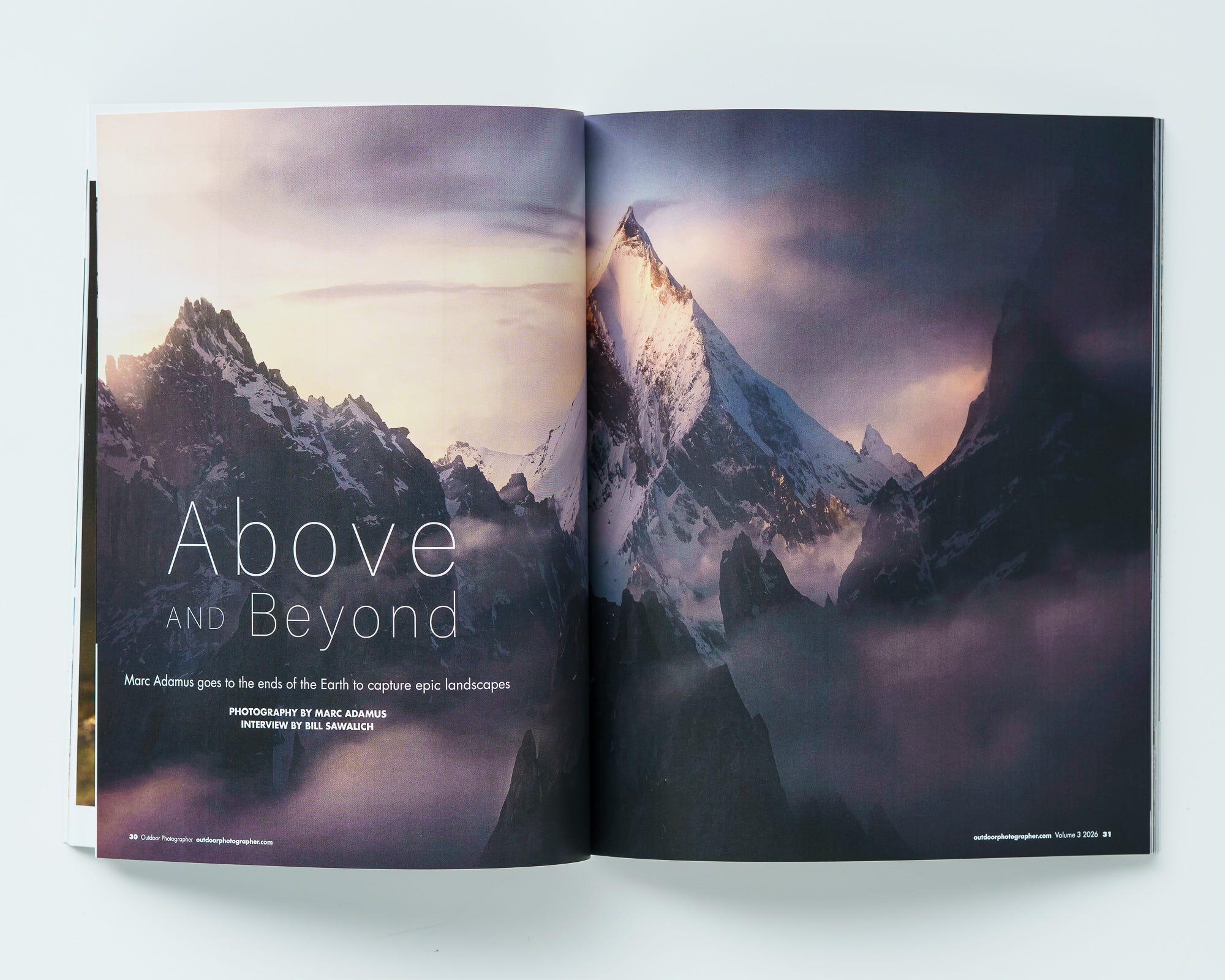
The whole issue is great, but two interviews are especially notable (because they’re mine). Along with Mr. Adamus’s longer conversation is a nice chat with German photographer Ingo Arndt. Mr. Arndt photographs wild honeybees. He went so far as to build a hive in a hollowed out tree in his back yard and outfitted it with studio-style lighting such that he could make never-before-seen pictures of wild honeybees. In the process he made genuine scientific discoveries. It’s pretty great and the photographs are stunning.2
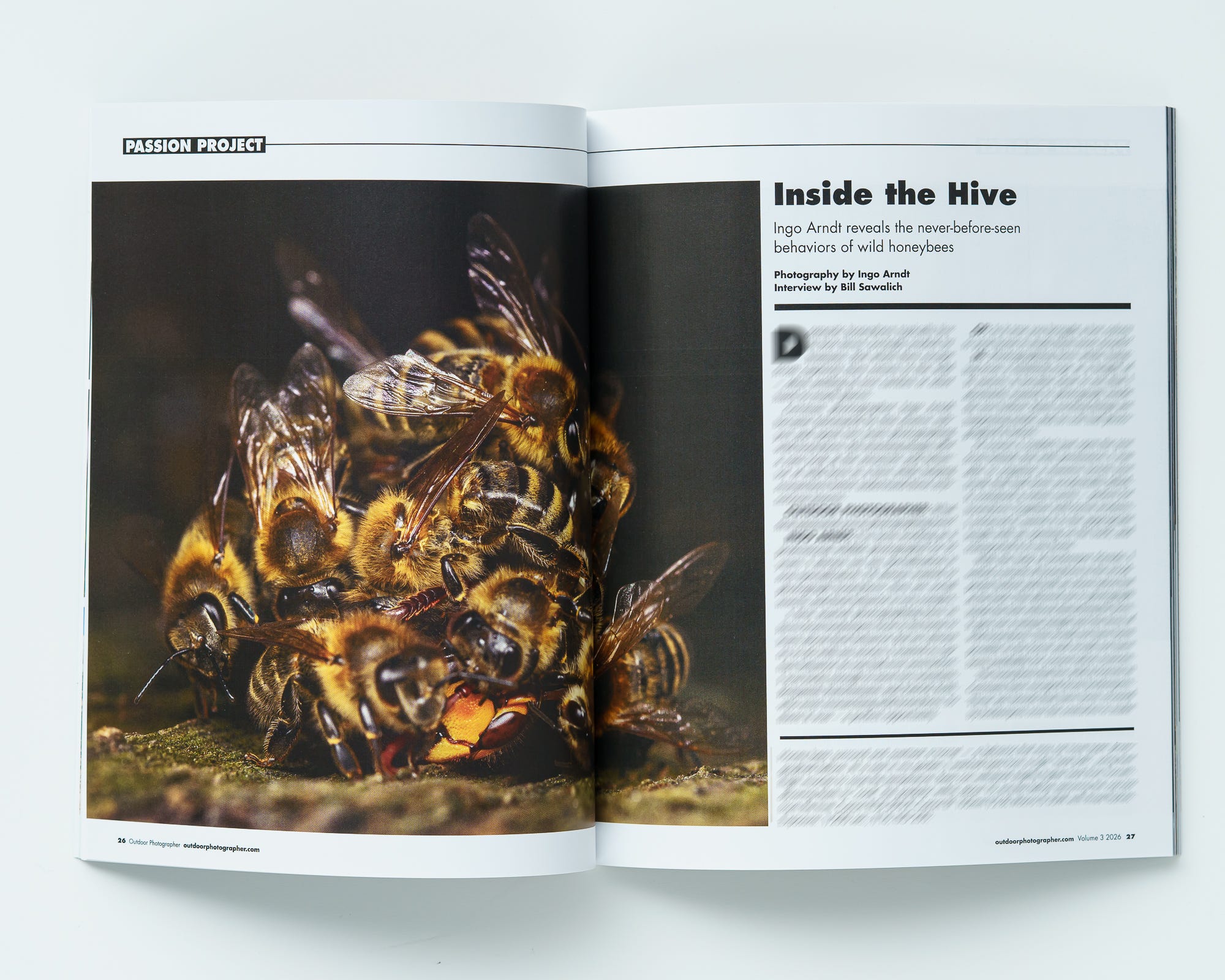
The Adamus interview was more wide ranging. I’d spoken to him before, in 2011 and 2013, when he was infamous in certain circles for doing Photoshop too well. I do not begrudge you, dear reader, your opinions about how any photograph “should” look — so long as we’re talking about photographs you’re personally responsible for making. There’s rules for photojournalism, of course, but for everything else, anything goes. It’s art. Do what you like. And if it’s somebody else’s art, you can hate it and that’s perfectly legitimate — but that doesn’t mean they did anything “wrong” by making art you don’t like. Consult the rule book and you’ll see I’m right.
Back in the olden days practically nobody thought this way, however. Some hater designed a website to throw Mr. Adamus under the bus. Talk about a petty waste of energy. I’ve disliked some photography but I’ve never felt compelled to blog about it aggressively.
The point is, Adamus was pushing boundaries 20 years ago when landscape photographers were still shooting film. He caught a lot of flak for it, so I asked if it ever bothered him.
“I mean… whatever. I was a pioneer, right?” he said. “There was a good five, six years where I was making images that almost nobody had seen anything like. You could go to photo.net in 2006 and you knew which image was a Marc Adamus image just from the thumbnail. When you’re doing something like that and people don’t really understand it, public perception always lags behind the state of the art. I was a lightning rod. But it’s just completely gone away, a totally different era now.”
I asked if he felt the pressure of that negativity back then, and if he feels vindicated now.
“If I felt it, I wouldn’t still be here to this day,” he said. “That kind of thing, it just doesn’t get to me. I guess it never occurred to me to feel vindicated. My philosophy always has been, on a personal level, to not change permanent subjects. Like what I would expect the viewer to see. For example, if a moon could never go over this mountain, then I’m not going to put it there. If this mountain wasn’t next to this other mountain, I’m not going to put it there. But you have a lot of leeway still with the light, the color, the atmosphere that’s in an image. And we like to practice the art of applying our own personal vision to that, making it our own, a fusion between ourselves and the nature that we experienced.”
I’m sharing these words with you because they didn’t make it into the print interview; I like to think of them like DVD extras.
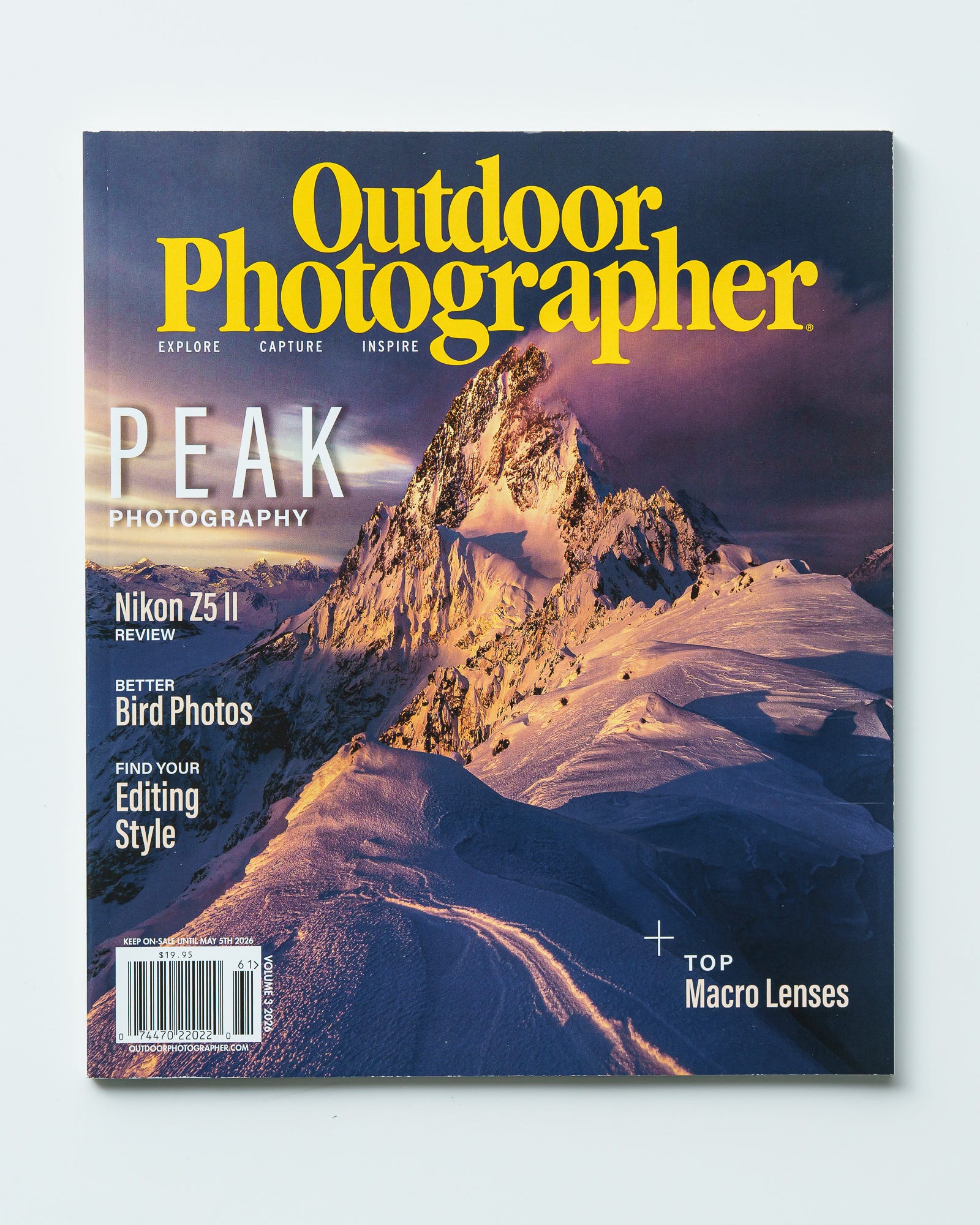
If you read the O.P. story, you’ll learn that Mr. Adamus flies to the farthest corners of the earth (Alaska, Patagonia, Pakistan) and when he gets there he takes a helicopter to even more remote reaches. And once he’s there he gets out a drone and sends it the last mile to get to otherwise unattainable vantage points — like the shot on the cover of the magazine.
“What drones do exceptionally well,” he told me, “is allow you to take panoramic images. I don’t typically composite images. I’m not taking images from different subjects at different times. But what I do a lot is drone panoramas. They come with a 28mm lens, a 60mm and a 140mm lens. With any of them you just automate your panoramic image, so you have the drone automatically take the number of shots you determine you need to make whatever perspective you want. And as long as there’s not a tremendous amount of movement — for example, waves exploding in the ocean or something — it’s pretty easy to do those super high-resolution images. The gimbal and the stability is just phenomenal.”
I often ask interviewees about the business of photography and how they’re navigating changes in the industry. I’m trying to earn a living with my camera3 so when I meet a fellow working photographer, especially one who is having success, I like to ask how they’re doing it. In 2026, that means addressing the elephant in the room: how are they earning a living since all of the traditional outlets for landscape, wildlife and travel photographers (magazines, stock, calendars, textbooks, etc.) have been decimated. In Mr. Adamus’s case, his main business is leading tours and workshops around the globe. Want to fly to remote places? He’s your guy.
“That’s my primary business,” he told me. “I still do stock here and there, but it’s not 15-20 years ago when I was contributing to 30 different calendars a year and that was my main business. There is still a pretty good fine art scene out there, if you’re willing to put the effort into selling big beautiful prints at spectacular locations around the world where people are buying that type of thing. But as far as stock and licensing, it just simply isn’t there. For somebody like me, that’s great because I started my career leading trips. That’s how I got into photography, so it’s just a natural fit for me. I really love doing that, making photography an experience first.”
“Social media has a tendency to focus people into the same areas,” he continued. “I think it directs people to the same types of things. That’s been exacerbated by all the trip planning options we have now. You could ask AI to just plan you a trip, it’s just going to take you to all the most popular places you see online. There is just so much more to the world than those places and I think you can find spectacular beauty and nature and light and atmosphere and all those things at any of those places.”
“I’ve always felt that way,” he added, “even before I got into photography. When I was doing climbing and wilderness trips, hikes, whatever… I have never wavered in my desire to not be in the same places that everybody else is going to. That’s just not a wilderness experience for me.”
To read my full interview with Marc Adamus, pick up issue 3 of Outdoor Photographer on newsstands at Barnes & Noble.
Ha!
See more in his book, Wild Honey Bees.
And with these words too, *cough cough*