How do we feel about photography contests? Are you a fan? They appear to be widely reviled while simultaneously remaining clearly profitable for the folks who host them.
I haven’t entered many contests myself. I recall submitting to Communication Arts in my youth. Surely there have been others. But it’s not something I’ve ever been terribly interested in. Maybe I would be if I was a better photographer, the kind whose work wins contests.
I have been asked to judge a few photography competitions over the years. It’s surprisingly challenging. You feel pressure to come up with a reason for why you like what you like. But if the instructions are limited to “choose your favorite” well then that’s a real task. Do you reward excellent technique? Creativity? Uniqueness? Something else entirely?
Here, try it yourself. Which of these three photographs is best?
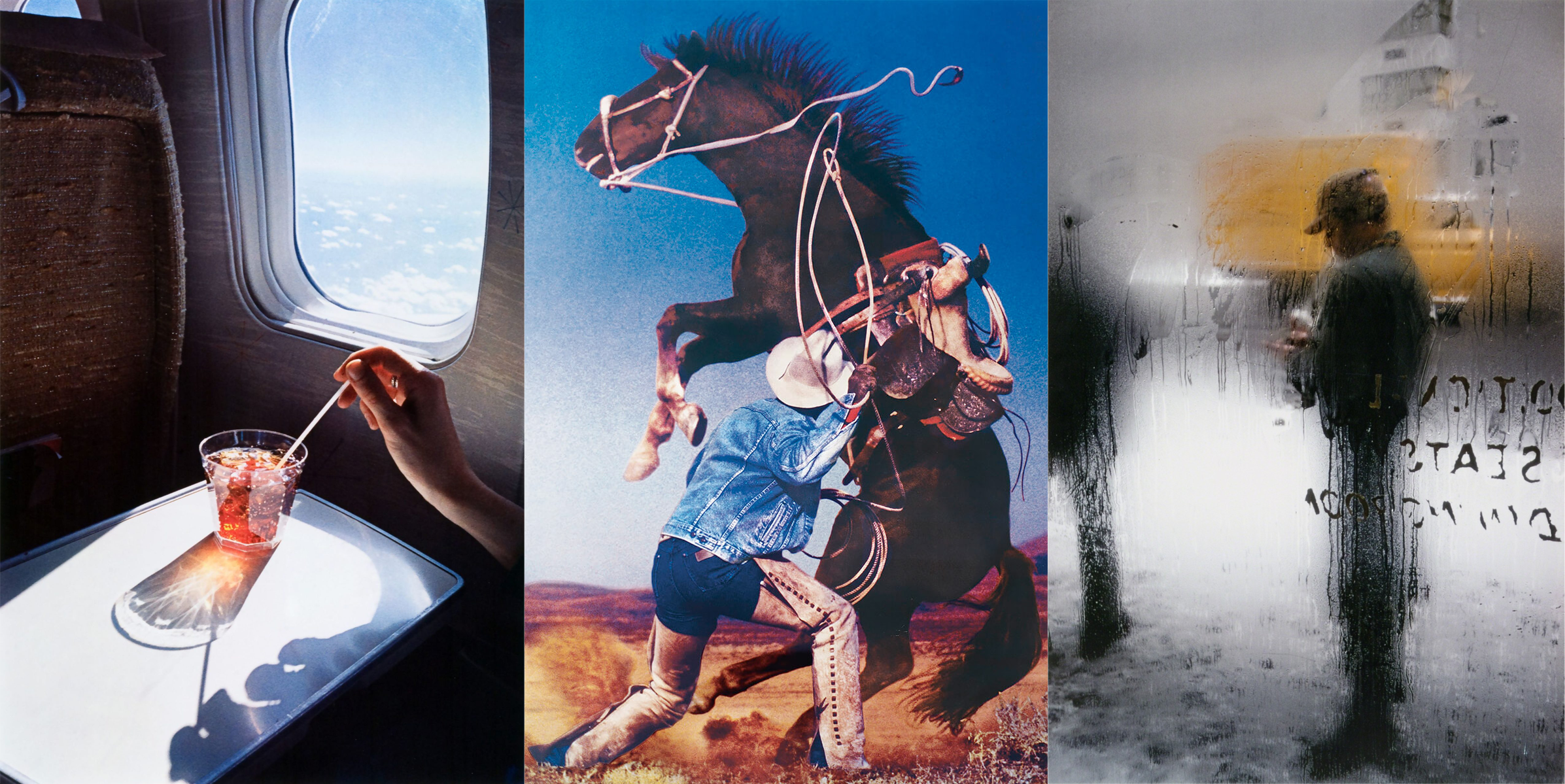
Is it the Eggleston, the Prince or the Leiter? Whatever your answer, I can’t prove you wrong (or right, for that matter). Because there’s no accounting for taste.
You like what you like, and maybe you’ll like something different tomorrow. This applies even if you’re judging a photo contest.
If I were smarter, and more cynical and profit-driven, I’d be telling you all about photo contests as a sort of sideways sales pitch for the first ever Art + Math photo contest! But alas, no such thing. No sales pitch, and clearly no profit.
I probably should start a photo contest, because it’s certainly a demonstrably profitable way to pay the bills. Publications and galleries and organizations host these contests all the time. For the most part, I see nothing wrong with a for-profit contest — or what I’ll call “creativity capitalism.” Nobody’s required to enter, and if the winner gets actual prizes and prestige, what’s the harm?
In one particular type of contest, the harm is in the form of a rights grab. I’ve encountered many organizations using photo contests as a way to get around hiring a professional for their photography needs. It’s diabolical, frankly.
Let’s say you run an organization dedicated to the preservation of architecture in a major American city. You need photography for your website and social media. You could hire a professional, sure. Or you could pick literally any dollar amount — let’s call it $500 — and offer that as the grand prize in the first ever “Major American City Architecture Appreciation Photo Contest.” Every entrant signs over full usage rights to their photo, and at no cost to your organization (beyond the $500 prize and the marketing of the contest) you get a stack of entries to use as you see fit. It’s the perfect solution if you don’t want to do any work and don’t want to pay a photographer. You won’t get the benefits of hiring a pro, but with enough entrants there are bound to be some decent shots. Infinite monkeys and all.
So a photo contest it is. And now, for $500, you’ve got your photography needs covered. Everybody wins. Well, almost everybody.
I work with a business publication that hosts networking events. They’ve become so popular that these events have actually surpassed the publication itself in terms of profitability. Now the events that were once a side hustle actively support the publication. The tail wagging the dog, as it were.
The same thing seems to be true for many photo contests. If a publication or a gallery or an arts organization holds a photo contest as a way to keep the lights on, it may feel a little icky (so much of “creativity capitalism” does) but where’s the harm? I saw someone refer to these contests as scams, but I don’t see it. If you don’t want to pay $20 to enter, don’t. As long as they aren’t stealing your rights, what’s the problem?
Some photo contests (and painting contests, writing contests, et al) charge entry fees not for profit motives but to cover costs of hosting the contest, or even simply as social engineering. If you’re paying a judge a stipend, or if the goal of the contest is ultimately marketing outreach, that funding has to come from somewhere. And if you don’t want literally everybody who sees the contest to enter it — a logistical and clerical nightmare — then a nominal entry fee is a great way to select for those entrants serious enough about their work to put a little money where their mouth is. No harm, no foul.
All this talk of profit has me reconsidering my photo contest idea. The problem for the entrant, of course, is that there’s some risk to entry. So I’ve got a solution: Send me $35 and a picture you like, and I’ll tell you it’s great and name it an official “Art + Math Photo Contest Award Winner.” I’ll even publish it or something? ¯\_(ツ)_/¯
Maybe I’ll have some ribbons printed up. For sure there’ll be a logo you can use on socials. What a brilliant idea! And all for the low low price of just $35. Hell, make it $50 and I’ll call it the Palme d’Or. In fact, for $100 you can tell me what to name it. For that matter, at the $250 donation level I’ll name the award after you! Ain’t capitalism grand?
I’m starting to see why galleries and publications and clubs hold photo contests.
Maybe I’ll publish a “Best of Art + Math Photography Annual 2026,” which should sound familiar to anyone who entered (and, surprise surprise, managed to win the Best of College Photographers annual competition.1 As a winner, of course you’ll want to buy the commemorative book containing your name and photograph. A fine leatherette edition can be yours for… let’s call it $65. Add a slipcase for another $30. Think of the prestige!
I’m really onto something here. Step one: photo contest. Step two: profit!
I now recall that I definitely did enter this one, and win, at least twice back when I was but a fetus. I still have the very expensive leather bound books.