Because I have odd hobbies, I was recently thumbing through a digitized copy of one of Alfred Stieglitz’s original Camera Work quarterlies — issue number 11 to be exact, from July 1905. The advertisements were charming as heck. Send a nickel for a box of sensitized plates. Or a quarter for a book of color photographs.
But one advertisement really caught my eye. I didn’t know they advertised for this sort of thing back then; I assumed this innovation came later.
It was an ad from the Goerz lens company, for which the headline read “Goerz Catalogue-cover Competition.”
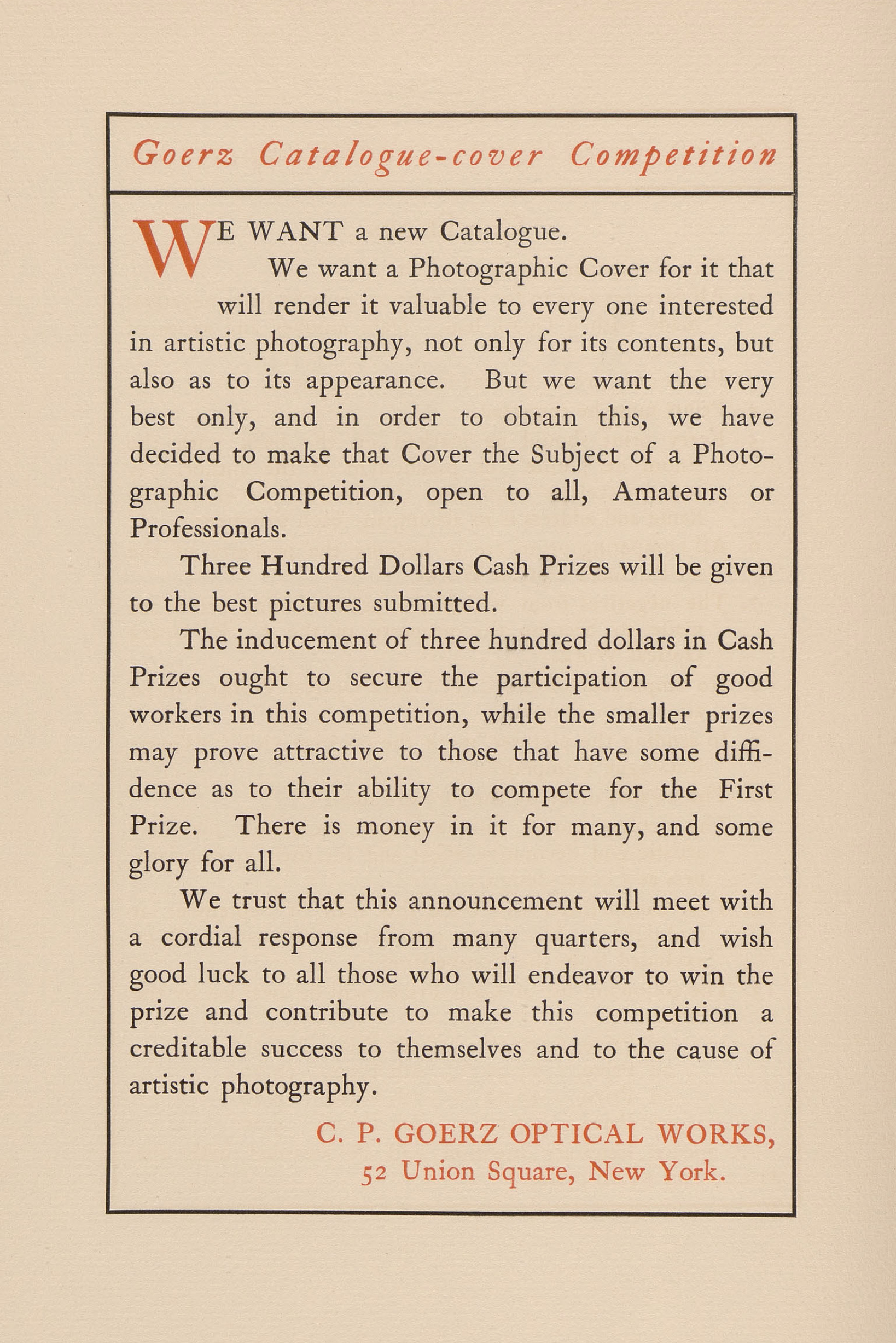
“We want a new catalogue,” the advertisement began. “We want a photographic cover for it that will render it valuable to everyone interested in artistic photography, not only for its contents but also as to its appearance.”
Hey, maybe this is for me!
“But we want the very best only,” the ad went on, “and in order to obtain this, we have decided to make that cover the subject of a photographic competition, open to all, amateurs or professionals.”
The prize offered (aside from the publicity, of course, and the prestige of being published) was $300 cash.
That may not seem like very much money. But in 1905, according to my inflation calculator, that amounted to the 2026 equivalent of… wait for it… $10,000.

Can you imagine a business — any business — offering a $10,000 prize for a catalog-cover-photo-contest in 2026? No way.
I was ready to roast the Goerz Optical Works for this blatant predatory business practice. Turns out I must celebrate their generosity.1
I searched as best I could but found no evidence of the company’s subsequent catalogs having photographs on their covers. Perhaps they simply didn’t find anything that rendered it valuable enough to those interested in both the appearance and contents of artistic photography. Or maybe they just didn’t want to shell out the dough.
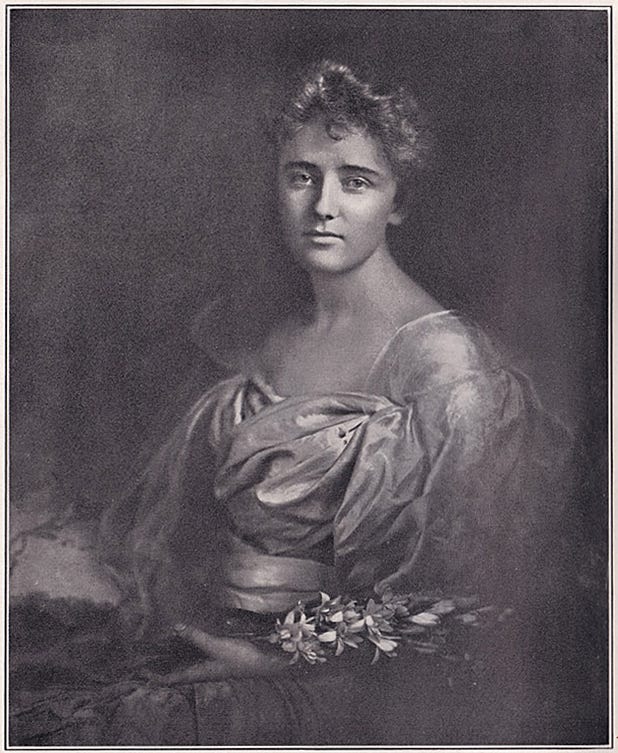
I did discover the interior of the company’s 1906 lens catalog did contain this stunner of a portrait that, apparently, was the winner of a Goerz professional photo competition. Whether Mr. J.H. Garo of Boston, MA collected his $300 is anyone’s guess. Does Mr. Garo’s name ring any bells? No? How about his apprentice, Yousuf Karsh.2
I don’t know if I was heartened by the discovery that the earliest examples of this scheme included actually meaningful compensation for the winning photographer, or disheartened to learn that this sort of thing is much less valued now. I suppose I’m comforted by the fact that the same things that motivate photographers to enter photo contests today were shared by our compatriots more than 120 years ago.
“Creativity capitalism.” The idea that the fastest way to make a buck in the arts is to convince a wannabe that the only thing standing between them and greatness is you and your nominal fee.
Regarding the Goerz contest, I do wish I knew how it all panned out. Was that $300/$10,000 a pie-in-the-sky, never-gonna-happen ploy designed to attract photographers far and wide for a prize with no actual payout? Or was it true, and evidence of how far the value of photography has fallen in the century since the medium was really coming into its own? I’m not sure which would be worse.
Goerz was a lens and camera manufacturer started by a German salesman with a specialty in mathematical tools. In 1888 they began manufacturing cameras and lenses and continued until 1972. If you’re familiar with the company at all, it’s likely for their Dagor large format lens. I think I might even have one.
Karsh said of Garo, “he was greatest influence on my life and career.” $300 and a legacy of training one of the greatest portrait photographers of all time? Not bad.