Have you heard about the AI Moonrise? I spoke of this on the Continuous Agitation podcast (listen here!) so I will summarize briefly before discussing what’s new.
In April, the Danziger Gallery in New York displayed a large print of an AI-generated colorized version of Ansel Adams’ famous photograph, “Moonrise, Hernandez, New Mexico.” You’ll no doubt recognize the original, and the AI version is an exact replica in garish color. The print was accompanied by a price tag of $10,000. Which is necessary, it seems to me, to really dial up the crass commercialism.
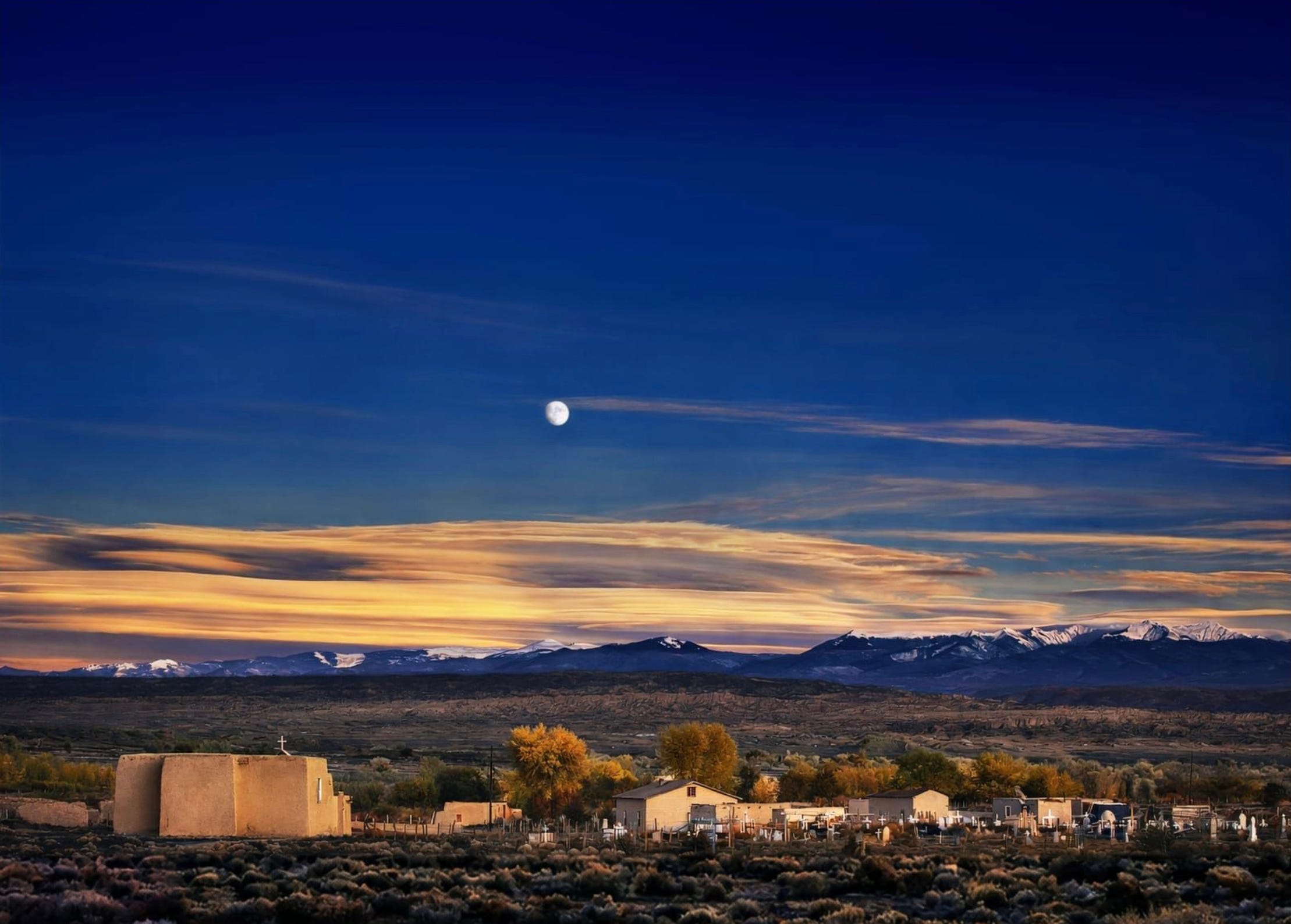
When we discussed it on the pod, it hadn’t yet received much coverage. (I’d seen a solitary tweet and that was it.) But since we recorded, there’s been growing outrage. Which seems reasonable. Key points:
• The Ansel Adams Trust released a statement which concerned itself not with the image’s AI nature, but rather the preservation of the artist’s (i.e. the Trust’s) valuable intellectual property: “No one should trade on another person’s name, reputation, and labor for private commercial ends without consent and candor. The unauthorized exploitation of Ansel’s actively stewarded legacy reflects a gross failure of ethical and professional judgment.”
• A photographer represented by Danziger, Jim Krantz, has, in protest, severed his ties to the gallery and will be seeking new representation. “Having experienced the appropriation of my own work — most notably Richard Prince’s use of my Marlboro imagery — I understand how important authorship and artistic integrity are to the creative process.”
• In the podcast, I mentioned that one of the gallery’s artists was credited with the piece, but I was incorrect. Gallerist James Danziger himself has since taken credit for the idea and its execution. (Well, inasmuch as typing the sentence “Colorize Ansel’s Moonrise” amounts to an execution. The death of irony, perhaps?)
• Danziger responded not to the public outcry but to the Adams Trust’s IP-based critique with a statement of his own, saying he believes the image to be in the public domain.1 He also strongly implied that he believes Ansel would’ve approved, and cites an Adams quote about the “astonishing developments” that await in electronic imagemaking.
• I asked Chat GPT to critique Danziger’s statement. “The black-and-white print is not a deficient version of a color reality waiting to be restored,” the machine said. “It is the artwork.” Pretty good! Maybe AI isn’t so bad all the time.
• Childish, hilarious people, such as yours truly, have been doing things like the above, and the series of Insta posts below, to bring a modicum of attention to the preposterous nature of the whole cheap thing. If I don’t laugh, I’ll cry.
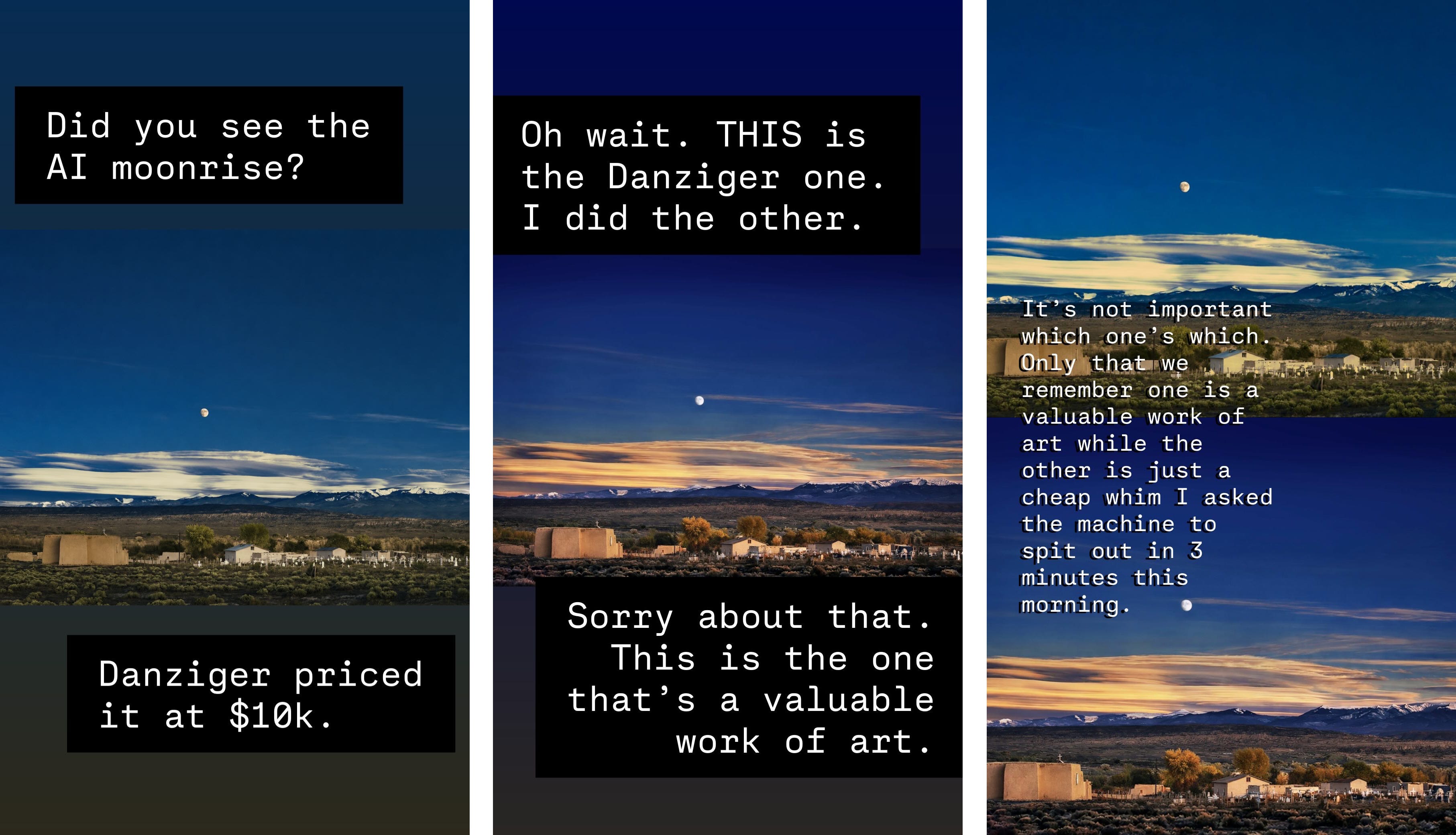
The whole thing is a bit of a poke in the eye a’la the work of rephotographer Richard Prince, or Maurizio Cattelan’s banana on the wall. The banana, to my way of thinking, is actually considerably more artful than this, because at least it represented an original thought. But that’s just personal preference. I find breaking new ground inherently interesting, and why my personal reaction to the colorization of Moonrise was largely, “Of course they did.”
I keep coming back to my prevailing feeling, which is best summed up as ¯\_(ツ)_/¯. It’s not exactly “who cares,” but I’m just unsure if there’s any lasting, meaningful consequence of this beyond the further cheapening of AI visuals as art.
I fault no artist for pursuing whatever mode of creative expression suits them. But, frankly, I’m just not very interested in AI imagery. Maybe that will change when I see it used in a way that I find interesting. It’s hard, though, because when I can’t find the artist’s hand I can’t connect very well.
Or is it that I don’t want to? Hard to say.
Did you see the guy who posted what he claimed to be an AI-generated Monet painting and asked for a detailed critique of the work? The cognoscenti tore it a new one, and in so doing walked right into the troll’s trap. He gleefully revealed, actually, it was a real Monet. He just wanted to see what we losers had to say on the subject. Or words to that effect. Now that is top-tier trolling.
I am not interested in being a hater just for the sake of it. Do your art, even if that means acquiescing to the machines. But I don’t have to like it, or appreciate it. I’m certainly under no obligation to respect it.
Neither are you obligated to respect me or my work, when I walk around pointing my camera at dirty parking lots or looking for beauty in my house at night. You’re free to dismiss my bullshit as I’m free to dismiss yours.
It’s when I can feel the rudimentary trickery, the shortcuts, that I balk. If it seems like you’re just trying to serve me chicken shit and tell me it’s chicken salad, I’m not likely to be intrigued. There remains an all-but-inherent positioning of this kind of work that keeps it, often, in league with deception. It’s used by unscrupulous salesmen, hoping to saddle me with a lemon and cash my check before I realize, miles down the road, I’ve been had.
In art, particularly in the places where it overlaps pop culture, matters of taste are going to be huge factors in the acceptance of AI. I can’t help but notice we seem to be, collectively, assigning a negative value to the ways it’s currently used. You see this in the slop-riddled comment sections of social media and in the backlash against anyone who employs an obvious AI “shortcut” to creative work that was, until a couple years ago, handled 100% by humans.
As I predicted (okay, in fairness, “wondered”) nearly 18 months ago, AI imagery could become so reviled as to doom it from the start. Like a high school cafeteria, if the right kids decree it’s uncool, soon enough the masses will fall in line. Then it’s too late. Once the prevailing wisdom becomes that AI art is slop, it’s a tough sell.
The question remains: will the masses get tired of the slop before they tire of hearing people like me complain about it? Too soon to tell.
The Adams Trust disputes this, and the image’s status has been in question, making it an exceptionally interesting choice for this project.